Thursday, April 27, 2006

Canada Dines on Passenger Rail

CNW Group is a Canadian news service (Canada NewsWire) that sounds like it should be a railroad. (It's not.) Their April 18 article reports the addition of enough equipment to add an extra 21-car trainset to the VIA Rail Canadian. The addition will give the thrice-weekly train a total of four trainsets. Hallelujah!


Imagine Amtrak taking a step like this.

Amtrak wouldn't know where to find the equipment. While the Amtrak board professes to be in a money-saving mode, they would prefer to have the extra crew costs associated with panic turn-around times and schedule recovery.

Horrors! A politically Conservative blogger is telling us all to look to Canada for an example!

You bet! (Sorry for one too many exclamation points here!)

Here's something else in the article. The Canadian is popular (they use the word legendary) for its "on-board fine dining, accommodations and attention par excellence." It operates full throughout he tourist seasons and it is one of the best patronized rail routes on VIA.

The last paragraph of the article spells out VIA's mandate. If you have read the previous post on this blog, you know what we think should be done with Amtrak's mandate.

Note to Amtrak Board: Buy more railcars including diners and sleepers, run your trains on schedule with equipment in good repair, put elegant meals before your patrons and give them a good night's sleep. The customers will come to the rails. © 2006 - C. A. Turek - mistertrains@gmail.com

Monday, April 24, 2006

Thinking About Easter and Passover

All right. We thought about this a week ago on Easter Sunday, but the idea is so striking that we are going to pursue it anyway.

The start of Amtrak in May 1971 was a type of Passover. We are not saying that the Amtrak Board got out there and smeared sheep's blood on the routes and equipment that they were keeping. But that's almost how it happened. What was left has wound up wandering in the desert ever since, and we don't know if 40 years will be enough. The commandments under which Amtrak operates are not etched in stone, but rather in disappearing ink on water soluble parchment.

Maybe Amtrak and Passenger Rail need a type of Easter. Maybe we need a wholesale resurrection of the passenger train where all sins are forgiven and the slate is wiped clean. Maybe Amtrak needs to start from scratch with a new contract with the government and with the freight railroads, with new equipment, and with a new outlook on what can and cannot be done with Passenger Rail.

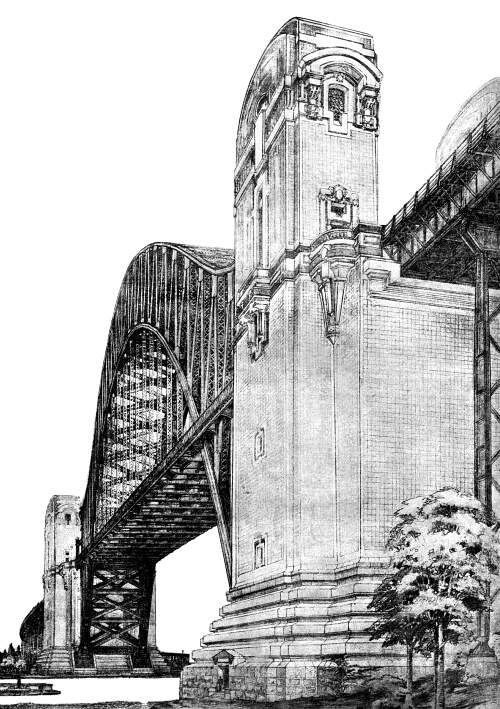
We will probably go to railroad Hell for this one (on the left is Hell Gate Bridge), but the analogy seemed so apt.

© 2006 - C. A. Turek - mistertrains@gmail.com

If you enjoyed this blog, please visit Mister Trains' Google Page.

Thursday, April 20, 2006

If You've Got The Money, Honey, We've Got The Train

Almost as a "given," we have repeatedly stated that Passenger Rail cannot break even or make a profit.

What about the proliferation of Tourist Railroads, Railroad Museums, and Dinner Trains? (And combinations of these three.) Some, like the Strasburg Railroad near Lancaster, PA, have been around and making money for a long time. And what about rail cruises?

This month's issue of Trains makes note of the rebirth of the White Pass & Yukon Route. This rebirth has been facilitated by the countless Alaskan cruise liners that call to the port of Skagway, Alaska, and send great numbers of passengers ashore to ride the trains up into the Alaskan wilderness. They are making money running passenger trains!

Dinner Trains, if run well, give the lie to those in government that would cut the heart out of Amtrak by cutting out food service. People flock to the dinner trains just for the fun of eating on rail and on the go. Some Tourist lines make money for their owners, others are subsidized. The same goes for museums. Strasburg is a synergy of Railroad Museum of Pennsylvania and the old line itself that seems to work well.

The rally cry of all these money makers is: If you've got the money, Honey, we've got the train. They all put their product out there on the market and price their product to make a profit. The target demographic is narrowly defined, and the level of product satisfaction within that demographic is high.

By contrast, scheduled passenger rail has to have a product to market. Many passenger rail agencies - we don't know of any privately operated, regularly scheduled, year 'round passenger rail routes - including Amtrak do not know what their product is supposed to be. Is their product transportation? Is it service? Is it speed or reliability? Is it just a string of cars that you can ride if you want to?

Amtrak thinks it is some of all of the above. Even railroad passenger routes before Amtrak had this kind of split personality. Some commuter routes still do. In part, it is because they do not have a narrowly defined demographic. Amtrak's demographic is anyone who wants to use a long-distance passenger train at any time for any reason, including transportation, recreation, or just plain nostalgia. Because these agencies are quasi-governmental, they must serve "all the people."

Being all things to all people necessarily means that the product satisfaction in any narrow demographic is going to be lower than it would be had the demographic been targeted.

So here's a proposal. Open up Amtrak's routes, and those of some of the commuter carriers, to bids from private "railroad event" operators. We are not proposing selling or leasing route structures. We think Amtrak should continue to operate a stable, coherent, and reliable passenger system. Just provide the trains and track (we know that the risk managers at the Class Ones are biting their nails at this), and let private enterprise pay as much as or more than it costs Amtrak to have the trains and track.

Boom! Suddenly Amtrak is breaking even, or making a profit. Let the private operators find something useful to do with the trains and track. Just lets be rail friendly. As we said in a previous blog (flag waving . . . just scroll down!) wave the right flag and make it so that the railroads and Amtrak have to bend in the right direction for the "something useful" to get done.

Something useful could be many things: Maybe just an express commute that's not being done now, but where the ridership would pay a premium for it. (Here in New Mexico that could be a train from El Paso to Denver. The Coyotes would pay a bundle. Ha, ha.) Perhaps new rail cruises, tours, historical outings, school field trips, etc., et. al.

Yes, we know it would take a little flexibility on the part of the operating railroads and a little know-how on the part of the contractor. (Rip Track, are you listening?) But it is not like they don't exist. And when was anyone with money and looking for a way to make more money on railroads afraid of running a railroad?

Just a thought.

© 2006 - C. A. Turek - mistertrains@gmail.com


Monday, April 17, 2006

What's Eating Amtrak?

Dinner in the diner. Drinks and snacks in the lounge. Activities revolving around food are part of the lore of the passenger train and certainly a big part of our everyday lives. When we vacation or travel for business, food becomes one of the perks. Even if we have to attend a stuffy business meeting, we can look forward to dinner in a new, if not fancy place afterwards. No matter how you got to the meeting, having new food experiences on the way and on the way back used to be something to anticipate.

Not if you fly or ride Amtrak these days.

What has happened to airline meals mirrors what happened to the great food service of Pullman Palace and Fred Harvey forty some years ago. In a funhouse sort of way. Because what is happening to airline food is grotesque.

George and Fred understood that eating is something we do naturally, compulsively, and almost always when we don't have anything else to do. These days, we also do it when we have nothing else to do but look at something, as in when we watch a movie or DVD, or when we watch the scenery roll by or pass underneath the aircraft. George Pullman and Fred Harvey built empires on the need of people to eat while traveling. They also saw the need for people to sleep, or to just get off the (fill in mode of transportation here) and stay still for awhile in a strange and exotic place. George wasn't into the food as much as the sleeping, and Fred only for awhile made sleeping accomodations available on trains. But Fred knew where to put a hotel.

But we digress, because my point is that What's Eating Amtrak is the same thing that's eating the rest of America. Politics.

Politics of late revolves around issues that mean nothing but hold the interest of a large group of people long enough that the politicians can slip something really important past that group. Amtrak is one of those "issues" that can be brought up at the drop of a hat when the discussion gets too hot on some other topic. Almost as many people have an opinion on Amtrak as they do on the War on Terror. Addressing Amtrak's "issues" is often done in rhetoric making it difficult to argue that anything is right about Amtrak.

Take the question of on-board food service. The rhetoric goes something like this: "Tax subsidies should not be used to provide services the public doesn't want. Amtrak diners do not cover cost, therefore, the public doesn't want dining car service enough to pay for it. If the public doesn't want it, then we shouldn't subsidize it." Does anyone see the falacy?

Amtrak riders want dining car service, and they are willing to pay for it. There is more than enough reason to believe that increased food prices accompanied by good food and good service would not deter ridership and may go further towards covering costs than cutting food service completely. Removing food service is undoubtedly one of the most idiotic things that the politicians and Amtrak's board ever thought of doing.

Removing diners and other food related services will undoubtedly reduce ridership, which will result in an Amtrak less ables to cover other costs. What will go next will be sleepers. This will reduce ridership further. The next thing they will take away is air conditioning, or seats, or . . . Amtrak.

© 2006 - C. A. Turek - mistertrains@gmail.com

Thursday, April 13, 2006

If You Are Going To Wave A Flag . . .

Please wave one that will do The United States of America some good, won't you? Don't wave the "free market economy" flag at Passenger Rail.

The free market economy isn't always good for passenger rail, and that goes double for fuel, as in doubling the fuel prices since the runup started. And there appears to be no good reason for it.

We heard an economist appearing on one of the morning NewsTalkFluffCrapAdvertiseDrugsandStuffforSeniorcitizens shows. You know, like Good Morning Today The Morning America Show (omitting one The and one Show). Here's the excuse for high fuel prices: (Are you ready?) The oil companies can get these prices in other places in the world, so they are going to try to get them here.

Whatever the traffic will bear.

Many commuter agencies and Amtrak probably locked in fuel prices with contracts that didn't anticipate the huge runup. If diesel fuel goes over $4 on the retail market, just you wait and see if any of them get the chance to lock in prices again. If not, we can anticipate a scramble either to jack up fares high enough to cover it or to raise taxes. Government subsidies probably won't begin to keep up, because of the mush heads in Congress. Or we can expect to see something like butcher shop pricing at the ticket window.

"Today's Prices: Amtrak $1.45/mile NJ Transit $.89 Metrolink $1.38"

Fuel charges or surcharges will change by the day, if not by the hour, if the railroads can't lock in some contracts.

What's good for Passenger Rail is good for America. The United States has a long tradition of subsidizing transportation; from waterways to The National Road, to Union Pacific/Central Pacific, to the national system of air traffic control, to the Interstate Highway System. It has served us well for 230 years, (Yes, Virginia, it will be 230 years on July 4, 2006) and it can serve us well for the next 230 years, if we can just get the mush heads out of Congress.

Wave a flag for what's good for America.

© 2006 - C. A. Turek - mistertrains@gmail.com

Monday, April 10, 2006

Passenger Rail and Security

Is Amtrak safe?

We don't know, but there are a group of Federal agents here in Albuquerque that do a heck of a job finding people that should not be riding Amtrak.

Out in the West, Amtrak runs over hundreds of miles of unprotected railroad in the geographic center of the Middle of Nowhere, and it does OK. We recall one historical incident of sabotage on the old route through Phoenix, AZ, but none recently and certainly none after 911. Actually, there are probably more route miles in rural, unprotected areas back east, but we would have to do some calculation to verify this.

Were Amtrak not rooted in traditional railroading; if it had a true hub and spoke system and automated boarding like the airlines; if it were a more spectacular operation; and if it were perceived that a significant disruption of service would be viewed as a catastrophe; yes, we think Amtrak would have more problems with security than it now does.

We would certainly like to see Amtrak have a more spectacular, more frequent, more dependable reputation. We would like to see passenger rail that everyone could depend on. It would seem that, from the standpoint of security, that would come with some costs.

As with commuter rail, we do not think it would be possible to do airline-like screening. Were we to develop a spot-check method for rail that we could depend on, then we would also like to see it applied to the airlines. But not before the passenger railroads recover a bit of their ridership.

The probability of detection is higher on trains, even trains that are out on the line between stations. The possibility of thwarting an attempt aboard a train is also higher. Cars can be switched, shunted, and put out of the train. An inexperienced terrorist couldn't likely operate a train with the bludgeon-like accuracy of a novice pilot in a jet cockpit. Even a diesel locomotive full of fuel isn't the firebomb that a fully fueled aircraft can be. Hazardous cargoes are another story, but we are talking about Amtrak.

For a lot of reasons, Amtrak and Passenger Rail in general is safe, or safer than the airlines, maybe even safer than Greyhound, when it comes to terrorist threats. When you are on a station platform waiting to board or just watching trains, and when you see the armed peace officer watching you, remember how much nicer it still is to ride the train.

On a Similar Topic

Norm Mineta, who, in our opinion, is nothing if not bad for Amtrak, was tooting the DOT's horn about successful tests of so-called collision proof passenger cars. (They reduced interior collision damage zones by about 50% in 30mph plus collisions, meaning some passengers still would suffer injury.) The goodness of the new cars will only benefit commuters for awhile. They way Norm and Company view Amtrak subsidies, it will be (a cold day) sometime after 2015 when Amtrak has even a chance of having cars built to these standards.

The good news is that the frequency of collisions resulting in crushing damage to Amtrak cars has been very low. They incur far more damage and far less passenger injury in ordinary derailments.

We still think Amtrak is safer, but we don't know if it's safe.

© 2006 - C. A. Turek - mistertrains@gmail.com

Thursday, April 06, 2006

Living Without Railroads

Let's start with the many.

We think it is safe to say that many people in the U. S. think they could live without railroads. It is even safe to say that many could. There are regions of the country where there are virtually no railroads, and never have been, and the people get along just fine. Historically, these were areas where self-sufficiency was a valued character trait and where travel occurred rarely. Today, these are areas where you don't live if you don't drive a motor vehicle and if you are not prepared to wait out the weather for one reason or another.

Logically, the number of people who today actually can live without railroads is probably much lower than the number of people who think they can live without railroads. The latter number probably includes some people in Congress, though the former number assuredly does not. (Self-sufficiency is a trait most politicians have only when you ask them if they have it.)

Let's move on to the few.

There are a few of us who know what life would be like in this country without the freight railroads, so living without them does not appear to be an option. Fortunately, there are also many who think that freight railroads are a necessary evil, or a silent part of our infrastructure, like sanitary sewers. So it is not likely we will have to live without them anytime soon.

There are also a few of us who believe that this country cannot do without passenger railroads, even knowing that passenger rail in all of its many forms has never proven to be a profitable enterprise. (The exception to this is tourist rail, which has proven over and over again that it has a life of its own.) There are a few of us who see the bleak future as commercial air travel goes through the same crises once reserved for the private passenger trains. There will only be a few of us able to travel around this country once the airlines are reduced to a government entity. (Perhap AmAir flying from the nearest AmPort by flapping its AmWing.) There won't be enough passenger rail cars left on wheels to go around. (Will Congress one day mandate that AmAir make a profit? Perhaps by stopping at airports along the way to pick up containers of Parcel Post?)

We see two routes past the same problem for passenger rail. On the one, Federal and State government cannot turn its back on passenger rail. Our country must have a viable system when a crisis strikes. On the other, private enterprise must not desert the concept of passenger rail, either. Will it ever earn a profit? We doubt it, if kept in its present form. But if the Few in Congress ever decide to level the playing field, we just might invest in passenger rail stocks. We won't say that, given the level of subsidy found in air travel, passenger rail could be profitable today. But tomorrow?

Write to Congress, and tell them you are one of the few who believe in passenger rail.

© 2006 - C. A. Turek - mistertrains@gmail.com

Monday, April 03, 2006

Sharing Railroad Goodies

Some of them are keepers.

We have been neglectful in posting some of the most interesting railroad things we have found on line.

We should have posted a link to the New Mexico Rail Runner screensaver long ago. It starts out with an almost Looney Tunes kind of roadrunner, and then goes on with the train running along several different stretches of New Mexico Track. Even if the train turns out to be a flop, this is a neat screen saver, and the Feds have already paid for it.

One of my favorites for just a lot of railroad photos and information is Fallen Flag Railroad Photos. This is a mix of just about everything, but there are some very good photos of passenger equipment to be seen.

Heavy on the Passenger Rail side is Dave's Electric Railroads. This is just full of photos of all kinds of electric railroading, including streetcar lines and rapid transit.

On the subject of rapid transit, check out www.Chicago-L.org if you are even remotely interested in the Chicago Transit Authority and its history. This site isn't so full of photos, but it has a lot of text and some spots where visitors can post their memories.

We don't know how to quantify it, but this one is one of the top five for just plain fun. Live Railroad Radio Communications has live hookups with train radio signals from all over, many of them on passenger routes. The latter include BNSF Railway in Chicago, BNSF Metrolink, Los Angeles, and Harrisburg, PA. There are, unfortunately, no direct Amtrak or commuter rail hookups.

Finally, for another interesting screensaver, go to this link, for an easy screensaver called Train Maniac that is just plain escapist fun to watch. It starts out with a maniac laying track over your desktop with the contents of the desktop showing behind it only in blocks where track is placed. Shortly, the little train comes running and tries to catch up with the maniac. Never does. Train Maniac is a bit of freeware.

We ask that you honor the copyrights of all of the goodies that we have linked in this blog.

Next time we share, we will try to find some interesting sites for those of you who are into simulations.

© 2006 - C. A. Turek - mistertrains@gmail.com

Thursday, March 30, 2006

Fantasy Rail

What routes would you like to see?

We're not talking here about routes that are possible, or even likely. What would you like to see? Some pretty outrageous passenger routes have even become reality, so put your mind to it and let us know.

When this writer was a kid, our fantasy passenger route went right through the back yard. It was a branch off the Burlington Route line that passed through Clyde, the large yard in Cicero, Illinois, along the three-track Chicago-Aurora speedway. Going west, the yard started at Cicero Avenue and ended right about Ridgeland Avenue. Today, much of the yard has been converted to intermodal transfer and there is almost nothing left of the steam ready tracks and the hump bowl that existed when we were kids. In the early 1950s, the yard was also crossed by the Laramie Avenue bridge that used salvaged trusses from a Mississippi River bridge that had been loaded on railcars and moved wholesale to the Cicero site.

A fantasy branch would have left the main line from Chicago just past Cicero Avenue, passed under Laramie Avenue, and proceed due west along 27th Street. This alignment would not only take it right past my boyhood home, with a station stop at 27th Street and Harvey Avenue in Berwyn, but would also allow the line to skirt Salt Creek further west (who cared about the environment when your were 10) and enter Oakbrook, an affluent suburban area sorely devoid of train service. So there could have been some practicality to my fantasy.

Throttling west, the fantasy line could eventually connect to the Chicago Aurora & Elgin in Warrenville, IL. (The latter railroad lasted only until 1957 as a passenger carrier.) In alternate format, the branch would be electrified with third rail or overhead and become a part of the CA&E going the other way, with a change of trains at Cicero Avenue or - more fantasy - an overhead wire strung all the way into Union Station. Our fantasy: Ride a local from my home station into Union Station, Chicago, or go west and change trains for an electric ride into Aurora instead of walking the 8 blocks or so to the nearest station on the Q.

Another boyhood fantasy involved the Douglas Park line of the Chicago L taking off from its right-of-way in the alley north of Cermak Road and running south through our back alley. Of course, there would be a station stop serving both lines right in our house. Probably a car service yard for the electric trains, too. (The Douglas Park line cut back to 54th Avenue in February 1952, two months before this writer turned 5 years old. Before that, it did run to Oak Park Avenue and crossed Harvey Avenue north of Cermak Road. Because our maternal aunt had an apartment on Cermak with a back porch above the L tracks, which ran at grade through the alley easement, we still remember it.)

Imagine how noisy our home would have been!

More about fantasy passenger rail routes another day. What about telling us some of yours for a future blog?

© 2006 C. A. Turek - mistertrains@gmail.com

Monday, March 27, 2006

Consider A Two-Seat Ride

For some rail commuters, there has never been a one-seat ride into central Manhatten. New Jersey Transit (NJ Transit) has many routes or combinations of routes that require a change at Secaucus or Hoboken. Some riders have no choice but to make a change, while others do have a choice of a one-seat ride. NJ Transit has recently considered proposals to add another tunnel under the Hudson so that one or more lines may be re-routed onto the island. The cost is astronomical and so is the lead time.

There is no realistic way to predict traffic patterns far enough in advance to know that the right decision has been made. Commuters now needing to get to offices on Wall Street may need to get from Metuchen to New Providence ten years from now. We just can't tell.

Step downwards in system size to New Mexico Rail Runner. It seems that absolutely the only routing to Santa Fe being considered is a one-seat ride from Albuquerque that will require enormous investments in right-of-way, grading, and track engineering. It may even require tunnels! Again, the cost is astronomical and so is the lead time. Even though Gov. Bill Richardson has been able to push through a project in record time, any remaining routes will have to stand for themselves whether Rail Runner in its current form stands or falls.

Why not a two-seat ride into The City Different. (For non-New Mexicans, this appellation seems either complimentary or derrogatory depending on which color of the political spectrum you sit. For New Mexicans, the term is accepted as truth.) The state is going to buy the old AT&SF line, so getting to either Kennedy (a railroad place, not a town, near milepost 844) or Lamy is a relatively easy proposition. The two points are separated by about 5 miles along the line, with the latter more distant from Albuquerque.

There are two existing rights of way into Santa Fe. The first is an existing roadbed from the defunct New Mexico Central with an easy grade into Santa Fe. If it were not for the fact that the final four miles or so have been obliterated by development, this would be a no brainer. But with the current property values in Santa Fe, astronomical doesn't even begin to describe the cost of land acquisition. (Some of the right of way goes near the current state government complex, and the promise of a station stop there makes this one politically correct.)

The second is the current Santa Fe Southern, which is the original AT&SF branch, the one the railroad built when it became apparent that it was too costly to run the main line through its namesake city. It is not a low grade line and has way too many degrees of curvature for a train the likes of Rail Runner.

HOWEVER (BENEFITS)

A. It is owned by the state. B. It has track and is operational. C. It ends in downtown Santa Fe. D. Traffic on the line is minimal. E. It also goes through the government complex, so the rest of us will have to stop there just because the politicians want it to stop there. (And don't tell me we will stop giving government cars to the state employees who already have them. I won't believe you.)

Here's how the two-seat ride would work on Santa Fe Southern: Rail Runner either buys light, high tractive effort self-propelled railcars or buys light, high tractive effort electric railcars and builds overhead wire. Passengers going to Santa Fe ride the diesel powered Rail Runner to Lamy and transfer to the light railcars. The light cars run singly or in two-unit sets and negotiate both the grade and the curves expeditiously. The taxpayers save a lot of money by not having to pay for new track and grade. Maybe we can kick in for a nice transfer station at Lamy, which is still also an Amtrak stop as long as the Southwest Chief exists.

Don't worry if Gene Hackman or Shirley MacLaine don't care to change trains, they will keep using their limos and their BMWs. This is way good enough for the rest of us.

© 2006 - C. A. Turek - mistertrains@gmail.com

Thursday, March 23, 2006

Now We Trust You

But we would still prefer you don't stand too close to the tracks.

The State of New Mexico has wired $45 million into BNSF Railway's bank account. What did we, the taxpayers, get for our dollars?

First, we bought a right-of-way. Hmm. Let's think about that. Fifty miles of right of way with an average width, according to actual maps, of about 60 feet. That's about 15,840,000 square feet. At my current assessment and tax rate for unimproved land, that's property taxes of $6,019,200. Lucky for BNSF Railway they won't have to pay that any more. Factoid: Nobody will pay it! It is now state land and the state doesn't tax itself, nor can any local municipalities through which it passes tax it.

Next, we bought tracks and switches and signals. A regular railroad infrastructure. A little research also tells us that the average cost for maintaining track, signals and grade crossings (not buildings) on a comparably sized railroad is $25,000 per mile per year. That's $12.5 million per year.

Hmm, again. We've got $18,519,200 per year. So far. And something tells us the right-of-way is wider than 60 feet in some spots. Also more valuable than a dollar a foot.

Next, we bought prestige. New Mexico is no longer one of the few states with no commuter railroads. Don't pull the tourism ads yet. We don't believe many will visit New Mexico just to ride these 50 miles of track.

We have also purchased a place to run our trains, which are costing us a bundle just to keep them idle. We wish we all had a place to run our trains.

And finally, we bought permission. BNSF Railway wasn't about to let us on the tracks until we ponied up the money and put up the bond to protect them from our own stupidity. But don't stand too close to the tracks with those nice commuter trains. BNSF still has to run some freights up and down to help us pay for the $63 million plus that we have to find in the piggy bank for the first year, before we even begin to have operating costs or revenue from Rail Runner.

Yes, Jose and Juanita, don't stand too close to the tracks. You get too close, you might just see how much it all costs.

(The author of this blog is based in Albuquerque, NM.)

© 2006 - C. A. Turek - mistertrains@gmail.com


Monday, March 20, 2006

Congratulations Metra

Now there's a commuter railroad that does things right.

This January, Metra, Chicago's commuter rail agency, expanded service on three corridors. This included new stations in, among other communities, Grayslake, La Fox, and Schiller Park.

This writer finds the La Fox extension particularly interesting. Ten years ago, when we moved away from the Chicago area into the dark railroad void of New Mexico, La Fox was a developing suburb well beyond the end of the North Western (now UP) West Line. The area has become frighteningly developed in those ten years. But what is more remarkable is the ability of Metra to work with Union Pacific to build a coach yard at Elburn (click La Fox, above, to see map) to replace the previous facility on the west side of West Chicago and just beyond the UP crossing with Elgin, Joliet & Eastern, aka Turner Junction.

The line through La Fox and Elburn is Union Pacific's transcon and the reason they bought the North Western in the first place. It's busy, and even busier now with trains going all the way out to Elburn. (The end of the line had been pushed well beyond West Chicago for a long time, most recently to Geneva on the Fox River.)

Metra, with 52 new trains and seven new stations, and the entire Chicago Area, we applaud your investment and initiative in passenger rail.

© 2006 - C. A. Turek - mistertrains@gmail.com

Thursday, March 16, 2006

Amtrak Near Death But Not Suicidal

Perhaps the Amtrak board has collectively consumed enough Prozac to keep them irrationally optimistic about Amtrak's future. (Consumer Warning: The link above does not necessarily take you to a site created by the manufacturer of Prozac, a product and registered trademark of Eli Lilly and Company.)

Perhaps the Amtrak board has collectively smoked enough New Mexico desert vegetation to take them to the same place. If they got it from somewhere near Trinity Site, there is a new movie out last week that will suggest reasons to stop smoking it. (None of the vegetation is registered or copyrighted. Side effects may be similar.)

But I digress.

Our point is this: Amtrak has recently undertaken two projects that suggest that Amtrak will continue to exist, and this is despite the fact that all Amtrak board members have their noses firmly planted in George Bush's butt crack.

We know that the trend these days is to put a bunch of money into projects just before a corporation goes bankrupt or sells out. It's only to reduce the value of the whole property enough to squeeze as much as possible out of the creditors.

Those of us who are optimistic about passenger rail would like to think that the rebuilding of the Thames River bridge in Connecticut and the opening of a boutique hotel in the Amtrak-owned station in Baltimore, MD, are both subtle indications that the board thinks Amtrak will be around in a few years when the projects are finished.

The first of these projects, the bridge, requires Amtrak to commit to service adjustments for the duration of the project. The other, the hotel, requires Amtrak to work with developers and sign a long-term lease for the property. In the end, both require a suspension of disbelief similar to what one has to have when viewing a movie to keep from saying, "It's only a movie."

In the case of Amtrak, we have to stop ourselves from saying, "It's only Amtrak." The whole country, including Congress and (yes - count 'em) seven administrations, has been saying that for years. If we would all get our collective heads out of our butts (and the Amtrak board's out of the president's), maybe we could be saying, "It's Amtrak! Ain't it a great railroad!"

© 2006 - C. A. Turek - mistertrains@gmail.com

Monday, March 13, 2006

Green Passenger Rail

Former Amtrak head David Gunn has been widely quoted as critical of the unwise course that the U. S. is taking in its heavily petroleum-dependent transportation policy. He has wisely criticized all modes in this way. To criticize only rail transportation would be like blaming a high birth rate in Rhode Island for a worldwide population explosion. (There isn't and I'm not.)

The heaviest user of petroleum per ton-mile is air transport, followed by highway and then rail. Here are the statistics: Air transport=60 to 65 gross ton-miles per gallon. Truck=120 to 200 gross ton miles per gallon. Train=750 gross ton-miles per gallon.

It seems natural, if not politically correct (see: State of the Union, Jan. 2006), to shift as much freight as possible to rail.

We were curious about passenger rail, as Mr. Gunn was recently the ill-fated head of Amtrak. A check of similar postings of statistics suggests that passsenger rail is, indeed, greener than either of airlines, buses, or personal automobiles, either cars or SUVs. Commuter passenger rail is better than long distance (read Amtrak), but Amtrak is still better than the airlines. Imagine that!

Bush Administration Monologue

Breath No. 1: "No money for Amtrak in its present configuration."

Breath No. 2: "We must end our addiction to oil."

What would a greener Amtrak look like? Apparently David Gunn didn't know, because there is nothing we can find to indicate that Amtrak was anywhere close to ending its use of petroleum products. Amtrak already uses electrified right of way where it is already installed, which allows it to buy power produced from fuels other than oil and from solar or wind power when available. Commuter rail in many parts of the country does the same.

While the current issue of Trains highlights Union Pacific's purchase of green diesel switchers, use of such switchers by Amtrak would be limited to areas where Amtrak actually does its own switching with its own engines. We know of no effort to produce a green or hybrid Amtrak locomotive. (The dual power engines on the New York corridor don't count, because when they are in diesel mode they run like a diesel locomotive.)

For those of you under 25, we might note that it has not been long since Amtrak and many commuter passenger rail operations switched over to head-end power. The power situation for passenger cars before that was more of a hybrid situation. Into the Amtrak era, some trains carried gensets, or diesel power plants, to light and heat the cars. Going back to the heavyweights of the early 1900s, the cars were powered by steam from the engines and by generators or alternators belt-driven from the axles and feeding banks of batteries, effectively making the locomotive and power system a genset charging batteries that powered things much like today's hybrids. The big difference is that we now have computers to control the process. ("Genset" is a relatively new term defining an internal combustion engine and electric generator on one platform that can be moved, changed out, or added to in a hurry.)

So if we are serious about ending dependence on petroleum for transport, here are our suggestions:
1. Start moving freight and passenger transport to rail and invest heavily in rail infrastructure and electrification in areas where non-petroleum power generation is most feasible.
2. Start developing more high-speed rail. The ton-miles per gallon go up as the speed goes up.
3. Start developing hybrid road locomotives.
4. Start converting away from head-end power.
5. Now that computer control has advanced into reliable, practical and cheap applications, consider coal as a fuel again. Another era of steam locomotives? Perhaps another ACE 3000?

© 2006 - C. A. Turek - mistertrains@gmail.com

Wednesday, March 08, 2006

Another Effort Up In Political Smoke - n' Mirrors

Several news organizations are reporting on the Virginia House of Delegates and their underhanded move to stop the effort to get a state transportation authority off the ground.

The aim of the bill's sponsor, formerly ineffective presidential candidate John Edwards, was to get rolling on planning for passenger rail to relieve the state's growing transportation difficulties. The authority wasn't even going to have bonding authority. But many in Virginia already knew that they needed this.

If not the states, then who? If not now, then when?

And On Another Topic
Readers may have noticed that we have allowed Google to place adverts at the top of our blog. It's a fact of life, and we don't get free blogs without it. And some of the revenue may support the continuation of this blogging effort in the future. If we get popular enough, we may get to contribute to some rail advocacy groups that can do some good.

Also, our apologies for using links that require you to register. Again, we see no problem with free enterprise and the need to somehow support the costs of maintaining all these free sites on the Internet. If we link to such a site, please use your own judgment as to whether you should register. We think you should never pay for these sites. Please report to us any sites that ask you to pay to see the article. Registration is one thing, because it helps to support the advertising base of the site, but paying for articles is taboo, as far as we are concerned.

And Yet Another
If and when the New Mexico Rail Runner ever gets to Santa Fe, the city fathers have pledged that it will go all the way to the old rail yard and not just to a station in the state government complex about a mile south of the yard. This area used to be the place where the AT&SF spur from Lamy met the D&RG narrow gauge line and another short narrow gauge, the Texas and Santa Fe Northern, that connected to northerly sections of the state.

(Interestingly, the TSFN was built because Denver & Rio Grande couldn't build into the town because of an agreement with the old AT&SF. Eventually, nobody cared about the agreement any more.)

The old New Mexico Central up from Torrance, NM, on the old El Paso and Rock Island (later Southern Pacific) made it to the rail yard for a time. The yard is currently served by the Santa Fe Southwestern, owned by the State of New Mexico. The rail yard is a short walk from the Santa Fe Plaza and the Palace of the Governors, we believe the oldest continuously occupied government building in North America.

© 2006 - C. A. Turek - mistertrains@gmail.com


Saturday, March 04, 2006

Back to New Mexico

Can't help going back to the subject of New Mexico's experiment in commuter rail. If you haven't read about it before, check my archives or go to New Mexico Rail Runner and read up.

Though the project is now about five months behind the original schedule proposed by NM Gov. Bill Richardson, and likely to be eight months behind before reaching fruition, it is still getting on line faster, from concept to first train out of the station, than any other similar project anywhere in the country. (Readers please challenge me on this if you can find one faster. I can't.)

NM Attorney General Patricia Madrid, as reported in the Albuquerque Journal has given her seal of approval to the legality of the contract to buy the rail line from Belen, NM, to Raton, NM. She just wants BNSF Railway to keep the portion up to Trinidad, CO, and everything is hunky dory, legally. She is not endorsing the concept or saying that she thinks it will be successful. She is running against Rep. Heather Wilson this year and needs all the votes she can get, and this whole Rail Runner thing could be a big flop by then.

Yes, Virginia, it will be a sure flop if it is over a year behind schedule, and it may be a flop if it starts running in June and we know how much money we are losing by November.

I don't want it to be a flop. (If you do, chime in with your two cents on the comments.) So if I sound too downbeat, please ignore it. I can't help thinking that the rail line is a pig in a poke and that the state would be better off without it. I don't see how the state will ever run a commuter train from Albuquerque to Las Vegas, NM. A more reasonable bet would be one from Albuquerque to Las Cruces and/or El Paso, TX. With Truth or Consequences (perhaps by then back to Hot Springs) as a tourist destination and three larger centers of population along it, Albuquerque to El Paso makes much more sense.

So why are we buying the line in the other direction?

I would love to have an explanation other than "Gov. Bill couldn't get his trains running in time for the 2008 Presidential Primaries if he didn't buy it." What a primary contest! Bill Richardson playing with trains and Hillary playing with . . . , oh, never mind.

Passenger Rail and politics are inseparably linked.

© 2006 - C. A. Turek - mistertrains@gmail.com

Wednesday, March 01, 2006

This Sums It Up

We ran across this article from the Sacramento Bee. Author Chris Ott is right on the money. We have been saying this all along, and saying it repeatedly. Politicians giving lip service to energy conservation fail to see the energy efficiency of a national passenger network. Those giving lip service to national security fail to see the need for all options for transportation to remain open.

Those seeking change for the better have failed to see Amtrak's steady growth and improved service in the face of tight budgets in anything other than a negative light. And those seeking political advantage have failed to see that using Amtrak budgets as a way to get more pork in the barrel doesn't really help home constituencies.

There's not a whole lot more to say, because Mr. Ott eloquently sums it up.

To Mr. Ott: Bravo!

To the rest of you: Write your Congressman

(Yes, I think Congressman is the proper form and is not misogynist. Even Congressman Heather Wilson from my district says this is OK.)

© 2006 - C. A. Turek - mistertrains@gmail.com

Monday, February 27, 2006

So It Has Come To This

Reading just a small selection of the hundreds of articles about passenger rail that are available worldwide on the Internet, I am sobered by one realization: On what appears to be a global scale, western civilization is back to building short segments of passenger rail for limited populations with very selective end points and service areas.

We are back where we were in the United States and England in the middle 1800s. It was a time when few railroads had enough resources to be more than local, and the ones that were bigger became only regional. The dream of a transcontinental system with long distance routes was decades ahead. Each route struggled for its existence and had no future without the prospect of interchange with other routes.

Today, the remnant of our post-World War II passenger systems it itself in shambles. The Federal position on Passenger Rail is that the states or regional transportation authorities should handle the cost. Though there is resistance, the evolution of commerce requires that regions and local governments that want Passenger Rail take the pragmatic course of action and begin planning for it. This is resulting in local and regionally viable systems. Viable, though, only to the extent that they receive tax dollars from a willing public.

Though it is always impossible to predict the result of a trend except in generalities, the result of this is likely to be a passenger system similar to what the United States had in the 1800s. Small local carriers will reach out to nearby suburbs and to close urban center. For example, Chicago will probably be able to hammer out a system that includes passenger service to St. Louis, Detroit, Minneapolis and, perhaps Cincinnati and Kansas City. Albuquerque, without the population density and financial resources, will reach only as far as its nearest urban neighbors.

Regional carriers probably won’t get too much larger. The Northeast will probably have a dense but complicated network, just as it does today. California will maintain a passenger system centered on the state with a density of service similar to what California had in the last half of the 1800s.

In a decade or two, perhaps three, as regionals absorb local routes and spread out to include additional urban centers, there will be a hue and cry for consolidation of passenger service and the revival of transcontinental, single carrier service. I hope I am alive to see this. But whether this will be practical will depend on two things.

The first will be the willingness of those holding the purse to understand that long distance passenger service will never be self-supporting. As a business, it will always have to be subsidized by some other kind of business or by tax dollars.

The second will depend on whether there are still a set of assholes in the government who don’t recognize the benefits of Passenger Rail.

One thing I am sure of. Steel wheels on steel rail will always be one of the most efficient forms of transportation available.

And the beat goes on.


© 2006 - C. A. Turek - mistertrains@gmail.com

Thursday, February 23, 2006

Tongue Firmly In Cheek - Let The UAE Run Amtrak

We see no reason to believe that our readers have not heard about the Federal Government allowing a Dubai-owned corporation to operate container ports on US soil. If you haven't, read this.

It got us thinking. Let's sell Amtrak to the United Arab Emirates. They are transportation experts on a world-class scale. We bet they would make a better job of it than the Federal Government. Of course, we might have to stipulate that they run it better than Congress has for the past 35 years.

But think about it! Luxury trains with legendary European efficiency run by a country with unlimited oil resources and plenty of cash. All the things that Amtrak has never had.

The Bush Administration says that one of the main reasons we let Dubai run the ports is that there is no American company that can do it. Well, they also say they want private corporations to run or compete with American Rail. If there is no American company wants to do it, we should let Dubai have them.

Something tells me they might do a good job. Maybe my tongue shouldn't be so far in cheek.

© 2006 - C. A. Turek - mistertrains@gmail.com

Saturday, February 18, 2006

Amtrak and Historical Perspective

Please read THIS ARTICLE, which appears in the online edition of The Ithaca Journal.

Never mind that the author, Raju Chebium, is relatively young and has no easily uncovered background in railroading. He could have gained his perspective by studying history. (Scary enough, his alma mater currently requires only one history course for a BS in Journalsim that we can see, and that is in African-American History. Not likely to give one a perspective in railroad history unless one is studying the Pullman Company.) Yours truly gained his historical perspective in railroading by reading literally hundreds of railroad books over the past 40 years.

So now we have our credentials established.

Chebium's first demi-quote from Jeff Rosen, member of Amtrak's board, is about the board wanting Amtrak to "wean" itself from taxpayer subsidies. Mr. Rosen also wants the states to pay more. What does he think state funding is? Chopped liver? With the exception of a very few states, like New Mexico, where funding may be able to come from depletion taxes paid for mineral extraction, state funding IS taxpayer funding.

Mr. Rosen has no historical perspective. Passenger railroading has never been a break-even proposition and never will be. Even in the glory days, it was only slick accounting tricks that made it seem so, for the benefit of stockholders. Freight subsidized passengers.

It may be that Mr. Chebium thinks he has struck some kind of balance in this article when he quotes an Amtrak passenger. The passenger just wants the government to leave her trains the way they are. In fact, the balance would be to ask other passenger modes to express their opinions as to how well they could function without government subsidy of some kind. These other eager "participants in the economy" as Mr. Rosen terms it, are easy to find. They are bus companies, airlines, and the driving public.

Mr. Airline would have to admit that he/she is already bankrupt and couldn't lift a shovel to build another control tower or flight service center without the help of government. Mr. Bus and Mr. Driver wouldn't be able to afford the maintenance on their vehicles, because without government subsidy, they would be driving them on dirt. Unpaved, ungraded dirt.

We did not arrive where we are today without a flawed transportation policy that favored political decisions over practical ones.

To try to pretend that Amtrak, or any other reasonable passenger rail network, could pay for itself is ludicrous, given any amount of historical perspective. To try to write a balanced article about how the Bush Administration doesn't hate Amtrak any more, without looking at what the Bush Administration is doing for other transportation modes, is just plain stupid.

© 2006 - C. A. Turek - mistertrains@gmail.com


Tuesday, February 07, 2006

Just Right and Just OK

While we would like this blog to cover all passenger rail in the United States and invite global comments, we find ourselves talking about RailRunner, the New Mexico commuter rail project, over and over again. Perhaps it is because the approach taken by NM Gov. Richardson invites criticism. Perhaps it is because the project is now indefinitely behind schedule. We are now four months past when Willie the Wet (see Rose Bowl Parade float) said we would have operating trains.

The trains sit in the bright Albuquerque sunshine south of the remaining Santa Fe shop buildings right about where the roundhouse used to be. The tracks needed to run the trains still belong to BNSF Railway. There is a draft agreement that calls for a horrendous burden of liability coverage and an enormous escrow for the same purpose if NM is to buy the tracks from Belen, NM to the Colorado border. There is a draft opinion that Willie wishes the AG, Patricia Madrid, would sign and make this coverage and escrow magically legal. (By the way, this writer’s background is in insurance. We know what is horrendous and what isn’t.)

There is a planned schedule that is already inadequate, in this writer’s opinion. More on the schedule later, and also see previous blog. And there are some parking lots being built without stations, because BNSF Railway won’t let Willie and the gang onto the property unless the sale is consummated.

Then there are two articles in the March issue of Trains, articles that make it perfectly clear to anyone interested in rail transportation that there are not enough tracks to carry all the freight trains. This means more heavily used tracks, either by virtue of expansion of track miles, signaling, or increased axle loading.

Why are these articles important? Because New Mexico has three transcontinental rail routes running through the state. Colorado used to have two, now it has one. Arizona has two, Big old Texas technically has only two, but Texas is really an Eastern State masquerading as part of the Southwest. (It has ports that take Atlantic shipping and no rivers that empty into the Pacific.)

The line that Willie is about to buy is one of the three transcontinental routes in NM. But NM is in poor position to capitalize on this unless we begin to recognize that BNSF Railway does not want it shut down. What they want to do is mothball it and save it for when their other transcon through Clovis gets too full. And then NM came along and wants the whole thing, and they are hoping we will invest our money, put in passenger train signaling and maybe some sidings, and then let them use it when they get in a bind. We will also be taking all that beautiful land off the tax rolls in not-so-prosperous NM counties.

(The third route is the Golden State Route from Tucson through El Paso to Tucumcari and beyond.)

Has anyone connected with the proposed purchase stopped to consider that NM is holding all the cards, not BNSF? Maybe, just maybe, we could get a deal wherein the state subsidizes the upgrading of this line in return for a stake in its future use. In the process, we get the right to run passenger trains, with no silly liability conditions other than insuring our own trains. The future use won’t come soon, but it will come. It will come because nowhere in the country can we build enough highways to handle our future economic growth.

If we can’t work a deal like this, maybe we should tell BNSF that we will give them first option to buy it back, when they have the need, in return for waiving the stupid liability rules.

Back to scheduling. The reason the schedule is inadequate is that the line is not signaled for commuter routes and we will have to add sidings and signals to make commuter trains really work, particularly at both ends. (In Albuquerque there are two main tracks.)

Nobody tells the public any of this. If only John Q. Public would read my blog.

© 2006 - C. A. Turek - mistertrains@gmail.com


Sunday, January 29, 2006

New Mexico RailRunner - How Are We Going To Get There?

The Mid Rio Grande Council of Governments (MRCOG) has posted it Draft RailRunner Service Schedule for Public Comment. (Click the link and read the .pdf file.) Not bad over all.

The following are my comments mailed to the MRCOG for their consideration.

Suggestions:

1. Get your train numbers more in line with railroad practice. Odd north and even south, or visa versa. Imagine the dispatcher trying to figure out which Train 3 he/she was talking about.

2. What makes anyone think that there will be nobody wanting to ride the train to Belen from Albuquerque during morning rush hour? Make at least one trip Albuquerque to Belen during the morning rush.

3. Same suggestion, different hours. Ditto 2 for the evening rush hour.

4. This schedule will take 3 trainsets to cover. Maybe I have missed something, but it seems you will have to return two sets light to their starting points for the next morning at the end of the day. (A consequence of ending the three morning trains in Albuquerque and beginning three evening trains there.) Can you get something more efficient? Perhaps if you have to run them at a loss anyway, perhaps the extra trips can carry passengers. Seems like it would make more sense to start all morning trains in either Belen or Sandoval and all evening trains in Albuquerque with some evening trains making 1.5 trips per evening.

5. If this schedule takes 3 trainsets to cover, have you accounted for the possibility that you will need backup?


If anyone has any better ideas, please post a comment or go to the Passenger Rail group on Google Groups.

© 2006 - C. A. Turek - mistertrains@gmail.com

Saturday, January 28, 2006

The AG Gets It - The Legislature is The Legislature

The Albuquerque Journal reported in yesterday's (January 27, 2006) edition that the AG for the State of New Mexico had some doubts about the deal wherein New Mexico is purchasing the whole line (260 miles) from Raton to Belen from the BNSF Railway for it's communter railroad that will only run (50 miles) from Bernalillo to Belen. Here's the link, but you may have to subscribe, so you may not be able to read it. Maybe they want to tear up the other 210 miles to use for repairs to the rather scruffy 50 miles.

By the way, the state is also getting industrial spurs in Albuquerque and other towns along the line. Oh, wait, there are no other towns with industrial spurs along the line. What's that about? And get this, it's not a bond to the tune of $50 million that BNSF wants, it is an escrow account! Tie up that kind of cash and see what you can buy with it!

The State Legislature is also meeting this week. (In New Mexico, they only meet once a year and no more than a month in off years.) They appointed former Governor Dave Cargo (apt name) to the Cumbres and Toltec board. But that is tourist rail, not passenger rail. The Legislature acts as though Rail Runner is out of their hands.

What this writer fears is that the state will eventually dump millions into this project (Rail Runner), only to have it fail, and the taxpayers will never OK it again in our lifetimes. See previous blogs about other portions of this boondoggle.

© 2006 - C. A. Turek - mistertrains@gmail.com

Wednesday, January 11, 2006

New Mexico Commuter Rail

Our January 8 blog mentions the Trains commentary about the firing of David Gunn as Amtrak president. We just wanted to note that the same issue of Trains has a multi-column article about the Rail Runner commuter experiment. You should read it, but it doesn't even scratch the surface of the questions brought up in our December 31, 2005 blog. Please read all of these and comment.

Thanks to everyone who has read our blog in the past year. Happy New Year.

© 2006 - C. A. Turek - mistertrains@gmail.com
Sunday, January 08, 2006

David Gunn and Amtrak

We have been reading the February issue of Trains, which carries a commentary by Don Phillips of the International Herald Tribune. Though we wish we could provide a link, Trains simply does not provide the content of his article on line.

Mainly, Mr. Phillips says what we said about David Gunn's firing, though we said it shortly after it occurred. While we would like to take credit, we haven't had any luck in getting Mr. Phillips to read this blog. If he has, it has been in stealth mode and he hasn't submitted any comments.

Bottom line, the firing of Gunn was political, based on fraudulent information at worst and extremely poor management by Amtrak's board at best.

More sparks will fly in the future.

(Please feel free to email this post to Mr. Phillips. dphillips@iht.com )

© 2006 - C. A. Turek - mistertrains@gmail.com

Saturday, December 31, 2005

The Train Isn't Running Yet - And Thanks For Noticing

(Also published in The Albuquerque Journal, January 17, 2006)

As a ten-year resident of Albuquerque who previously lived in the Chicago Area where commuter rail is a way of life, and as an amateur rail historian, I find Albuquerque’s and New Mexico’s entry into the commuter rail business both frustrating and laughable.

Let me first make it clear that I am a staunch supporter of passenger rail as one of the few viable transportation modes of the future. Gov. Richardson and the Mid-Region Council of Governments should be praised for taking a courageous move into the railroad business.

That we are now seeing missteps that will probably take the start of this service well into 2006, and perhaps into 2007, does not surprise anyone familiar with commuter services in other cities. Even Chicago’s Metra, an agency that started with an already functioning system of commuter railroads, is ill equipped to accomplish a new-service startup in so short a time.

Why compare Albuquerque with a metropolitan area the size of Chicago’s? The answer is that Metra, the commuter rail agency in Chicago, has to run many of its trains on tracks owned and operated by BNSF Railway. In order to do so, it has to negotiate contracts with BNSF that necessarily include all of the elements of such operating agreements or purchase agreements that we have to deal with here in New Mexico.

The people at BNSF are no dummies. They have years of experience in getting what they want and need from commuter rail agencies. And no freight railroad today “needs” to have passenger trains. BNSF appears to have seen New Mexico taxpayers coming with their wallets unzipped. They have sold – or tried to sell us a line that doesn’t mean very much to their traffic structure. It is a line they would have considered putting in mothballs if they didn’t have to use it to run Amtrak twice a day to keep the Southwest Chief off their “transcon” through Clovis. That may tell us something about its condition. And now they have asked us to indemnify them from their own negligence if something goes wrong.

For 2006, Metra budgets $1,276,081 for insurance claims and risk management for the BNSF Railway. These figures are only for BNSF lines and come from Metra’s published 2006 budget. Their total projected revenue from trains operating over BNSF lines is $42,765,965. This works out to somewhere around three percent of revenue. By contrast, BNSF is seeking $200 million in coverage and a bonded indemnity of $50 million from New Mexico. The Mid-Region Council of Government has not published any revenue projections that I have seen. However, there are those who believe that the cost of $250 million in liability coverage for the State or MRCOG is in the neighborhood of the same $1.2M that Metra has budgeted for a $42.7M revenue operation. Even at what could probably be a prohibitively high fare of $4.00, New Mexico’s operation would have to hit 10.8 million riders the first year for this kind of liability expenditure to even begin to make sense.

The proposed outright purchase of the line from BNSF raises a number of other troubling questions that I think should be asked soon and in a public forum. Some of these questions are: In what condition is the line from Belen to Raton? Does anyone realize that the line above Lamy is mountain railroad with relatively slow running and high maintenance costs? Does anyone realize that none of the line being purchased can be used to get into Santa Fe? How much will have to be paid to Herzog Transit Services, the contractor that MRCOG has hired for maintenance of way? How has Herzog performed in meeting its obligations under contracts with other commuter agencies? Will Herzog be maintaining the stations? What about the new station in Albuquerque? What is happening to the equipment already on the property? Has the manufacturer extended warranty expirations to account for the delay in implementation of service? Rail technology is changing a mile a minute, so who will pay for needed upgrades in hardware and software when the equipment is finally operational?

Because I know the answers to some of these questions, my opinion is that many citizens will not like the answers. Putting all our rail money into Rail Runner and leaving Amtrak passengers to use our Amshack, for example, is simply the tip of the iceberg of bad planning.

I strongly hope that such problems can be efficiently addressed in a public forum and that passenger rail can take its necessary place in balanced public transportation for the region. Until then, it seems, Rail Runner will continue to frustrate me and make me laugh out loud.

© 2006 – C. A. Turek – mistertrains@gmail.com

Friday, November 25, 2005

Raise Your Hand If You Don't Get It

Before I go off on the rant that I’d planned for this entry, let me just take you to this article. It caught my attention, because it is just further evidence of the strange and wonderful phenomenon that is taking place in the heartland. I am referring to common sense and practicality, two commodities that had become almost completely missing during the Clinton years and that promised to be relegated to obscurity as debates over the War on Terror heated up.

Here we have a passenger rail entity that, by almost every account, does everything wrong. Even though most of the beautiful people of Iowa know that Amtrak (reportedly) does everything wrong, they are willing to patronize it more than ever before. Some probably did it because it made common sense to ride the train. (High gas prices and crowded highways, bankrupt airlines, body cavity searches of Grandma and Grandpa Terrorist) Others probably did it because it was practical. (The station was right down the street and Uncle Wormy was going to pick them up at Union Station and drive them to his place.) I would bet that another bunch of the extra 7000 riders did it because of both common sense and practicality and also because they started to realize that the Federal Government has put Amtrak on a downward slide and they may never get the chance again.

My rant for today was going to be on one of two other subjects, and I won’t have time for them both. So I will cover how Bill Richardson is screwing up commuter rail for New Mexico in my next blog.

The remaining subject is how quickly “old media” is ready to condemn the passenger railroad for something it didn’t do. Read the recent articles in the Chicago Tribune, such as this one. This article was written after some common sense people started looking at the cause of this accident. But when it had just happened, all the wire services were reporting that the train’s engineer was being questioned for purposes of determining “human error.” Except this time, the human error was with the dunderheads that pulled out over a well-marked, warning-posted busy commuter line and stopped in traffic. What part of “long crossing, do not stop on tracks” didn’t they understand?

© 2005 - C. A. Turek - mistertrains@gmail.com

Monday, November 21, 2005

It's My Blog!

I can be biased if I want to be. It’s my blog, after all, and in my little corner of the Internet, I can say what I want. (Subject, of course, to the rules and regulations of this wonderful host that, through its infinite grace, allows my blog to stay on the Web—followed by giant sucking sound.)

I don’t have to present the other side of the Amtrak Board Fires David Gunn Story. But here it is, from about as Conservative a source as you can get. Please read this article.

If you have read far enough into this article, you will find that it begs the question:

Does A Conservative Have a Heart?

The author of the heritage.org article makes a pretty good argument about why Mr. Gunn should have been fired, and then he buries the rest of his article in the statistics of telling Mr. Gunn what he should have done.

I agree. Cutting sleeping cars and diners from the trains would have saved a lot of money. Or would it?

Passenger trains are more than cold, hard, money-losing transportation machines. Passenger trains have an emotional life. They have a historical life, and a tradition. They are a culture unto themselves. And if you strip out the heart and soul of the long-distance passenger train, you may as well be riding in a commuter coach on a one-hour ride to your high-rise office in the city.

Nobody will want to ride them, but maybe that’s what the Bush administration wants.

There are certain things that the passenger train must retain. Starting with reasonable comfort and reasonable timeliness, the list also includes food and beverage service, sleepers, the service of a fine hotel, and the conveniences of everyday life (morning paper, a midnight snack, etc.). To bring the passenger train into this century, perhaps we also need wireless Internet and satellite radio, but these new things aren’t part of the heart and soul. (By the way, I would draw the line at Dish Network, even for the 21st Century list.)

I don’t know if passenger trains will ever be as good as they were “back in the day.” I don’t know if anything will. Our quality of life seems to have peaked sometime in the last century. (I’m sure that about 30,000 GM workers will agree with that statement.)

But I do know that only a political conservative without a heart could strip off the diners and the sleepers and still think he was riding “a train.” Let’s crunch whatever numbers are necessary to get long-distance passengers back on the railroad, but let’s not gore the heart and soul out of the passenger train.

©2005 - C. A. Turek - mistertrains@gmail.com

Monday, November 14, 2005

That's Just Peachy!

That’s just peachy.  See this article.

The Amtrak board of Bush sycophants has fired David Gunn, and thereby has decapitated the dying patient in the presumed interest of saving the organs.  That’s all that will be left when they get done, the organs will be sold to the highest bidder or apportioned among those states that may still want a remnant of intercity passenger rail.

Poor Mr. Gunn.  In this writer’s humble opinion, though possibly sometimes the most infuriating president that Amtrak has ever had, he is the single most experienced and capable president Amtrak has ever had.  And he “slowed the pace of change,” the stated reason for his dismissal, because he recognized that it was the only way to accomplish what needed to be done in terms of preserving any realistic system.  

Mr. Gunn had Amtrak on the road to financial stability.  This infuriated the Bush Administration and Amtrak’s so-called board, because they wanted him to fail at this task.  They saw him as the last of the breed and the highly-experienced scapegoat for the agency’s ultimate collapse.  Instead he became—what appeared to most of us interested in intercity passenger rail—a savior.  

Perhaps the board will hire New Mexico Governor Bill Richardson, who is doing a bang-up job of getting New Mexico back on passenger rail by letting us all watch the equipment stand idle near the abandoned Santa Fe shops in Albuquerque.  If he decides to park the equipment from the Southwest Chief there, I, for one, won’t watch it.  

Write your representative.  Write your Senators.  Legislation is the only thing that is going to stop this slide into oblivion that will make the United States the only major industrialized nation that does not have nationwide intercity rail passenger service.  

© 2005 – C. A. Turek – mistertrains@gmail.com