U.S. RAILROAD & PASSENGER RAIL - NEW FORMAT; Same great posts about railroading in America.
The contents you are looking for have moved. Please bookmark the correct page at http://caturek.wix.com/u-s-railroad . The redirect has been disabled, so you may use this site to access the archives before January 2015.
Friday, January 02, 2015


Sunday, October 19, 2014
 Just realized I haven't posted to this blog since Labor Day. What with getting my new novel about my train-watching detective Charlie Komensky before the reading public as of October 1, 2014, and everything that entails, there hasn't been much time for blogging, let alone writing my fiction.
 Amtrak just keeps plugging along getting worse and worse, and the powers that be seem to think they are doing everything possible to keep Amtrak viable. They're not.
 Part of the problem you can read about here in this article. (Click on image.) Yes! Moving crude by rail is eating up a goodly portion of the capacity of our rail network, and the feds don't seem to give a damn. The railroads certainly don't, to the extent that they are able to set rates and make money to suit their needs. The railroads do not need Amtrak, and probably some, if not all, wish Amtrak would simply go away.
 Another part of the problem is Amtrak management. There is reportage, and evidence, that the current Amtrak CEO has not even tried to spend allocated funds that could improve service. He has put the railroad on the declining side of the 40-plus year old roller coaster with the old reduction of long-distance sleeper services and rationing of, of all things, bottled water for sleeper customers.
A couple of other things are also discouraging to old passenger train riders like me. No the least of these is the airline-like pricing for seats. If the airlines were actually making this system work to the extent that they were grossly profitable, this would make sense. But the airlines are on the same declining side of the roller coaster that the railroads traveled back in the 1960s, when constant reduction in service and reliability and increased discomfort and a disdain for the customer eventually led to Amtrak. Another discouragement is the push for pets on Amtrak. I don't know about my readers, but I know human nature. This is a situation that could get out of control. For an allergic person, it could be fatal. I don't see where the cleaning of Amtrak rooms and coaches is ever going to be complete enough to counteract pet dander.
The real facts are these: You can't rely on Amtrak to be on time unless you are somewhere in the Northeast or Pacific Coast. Otherwise, forget it. You can rely on Amtrak to be late, uncomfortable and too expensive for the kind of customers they are courting by turning the diners into bad fast-food restaurants and the sleepers into bad motels. At this point in time, I can almost rent an RV and travel across the country in more comfort and less trouble and expense.
So blogging Passenger Rail lately has just gotten my blood pressure up and not done a whole lot for my love of railroading. I'll go nap now and you can wake me when the feds decide to develop a comprehensive transportation policy that makes sense and includes trains that are on time and easy to ride.
©2014 - C. A. Turek - mistertrains@gmail.com
Monday, September 01, 2014
Passenger Rail and Labor Day

As a day to honor "labor" and labor struggle, Labor Day has never been that in my lifetime. (That is: 2nd half of the 20th century until today.) Labor day has always been a day to sell furniture and school supplies and for those who had a manufacturing-related job to have a good day off before fall and the so-called "holidays" set in. Too few of us now have those jobs. It's all service industry, which you can read as retail, wholesale, or transportation. Most of those jobs don't get a whole day off, or even half.
So, as this is a Passenger Rail blog, I want to start by thanking the thousands of employees of Amtrak and every commuter rail system in the country for working today, getting us where we want to go, without using up space on highways and in one of the most fuel-efficient modes of transportation. We need more of you and more of what you do. (Thanks to everyone else who is working today, as well, because I just would not have been happy if I could not have stopped into the Valero station and gotten a lotto ticket.)
I close with why we don't have more passenger railroad workers and more of what they do. It's bad management. Government management. And bad ideas filtering through a committee process that no self-respecting private corporation could tolerate and still make a buck. No matter how I figure it, I still can't see why Amtrak can't make a profit, or at least break even, if the managers and Congress will let it. Stop tinkering with the details and make a decision that America needs Passenger Rail.
One final word. The success or failure of Passenger Rail has never been about the people. Railroaders are hard workers who love the job and wouldn't stay with it if they didn't, because it's hard. It's hard on people and hard on their families. If you don't like it, you don't just do it badly, you just don't do it. So in that vein, I guess that the hard work of railroaders is what made Passenger Rail great in its heyday, and can make it great again. We built this country. Let the politicians go to blazes.
Thanks again, and Happy Labor Day.
Wednesday, August 20, 2014
Short Video Documentary - Railroad Preservation - Worth Watching!
I'm taking a different path with this entry and recommending this documentary. The filmmaker, Julien Lasseur, approached me and asked that I review the short film. It is certainly excellently done, and worth every second it takes to watch. Here's the film:
In the shadows of Cleveland's once prosperous steel mills, Charlie Sedgley and his fellow members of the Midwest Railway Preservation Society work to bring historical steam engines and railcars back to life.
Julien says, "When working with Charlie, most of our footage came from the tour he typically gives for folks who visit the Society. Afterwards, we sat down with him and had a conversation. When we find a subject to profile, we prefer to approach them first and foremost as an interlocutor - one side of a dialogue between us and them, with our cameras as one of the many tools in the formula. We do our best to stay reactive, and follow wherever the conversation takes us. With this ‘sense of adventure’ or receptive approach in mind, we hope that the stories we uncover speak for themselves."
I wish Julien the best of luck in continuing his proposed series on America's industrial heartland.
*Video copyright by the producers and/or Julien Lassseur. Contact Julien Lasseur at julienlassseur@gmail.com for more info.
©2014 - C. A. Turek - mistertrains@gmail.com
In the shadows of Cleveland's once prosperous steel mills, Charlie Sedgley and his fellow members of the Midwest Railway Preservation Society work to bring historical steam engines and railcars back to life.
Julien says, "When working with Charlie, most of our footage came from the tour he typically gives for folks who visit the Society. Afterwards, we sat down with him and had a conversation. When we find a subject to profile, we prefer to approach them first and foremost as an interlocutor - one side of a dialogue between us and them, with our cameras as one of the many tools in the formula. We do our best to stay reactive, and follow wherever the conversation takes us. With this ‘sense of adventure’ or receptive approach in mind, we hope that the stories we uncover speak for themselves."
I wish Julien the best of luck in continuing his proposed series on America's industrial heartland.
*Video copyright by the producers and/or Julien Lassseur. Contact Julien Lasseur at julienlassseur@gmail.com for more info.
©2014 - C. A. Turek - mistertrains@gmail.com
Sunday, June 01, 2014
Ebb & Flow
No, the title of this blog is not a new country duo--nor is it the name of my legal team. It is what happens with Passenger Rail in the U.S. with Amtrak and Congress, that singularly mismatched duo, running things.
 During the first decade of my life, Passenger Rail was full flow. Post WWII streamliners came on line faster than Sbarro on Manhattan Island. No matter what the railroad was running things, a serious effort to please the traveling public and make Passenger Rail competitive with air travel and highways created the grand days of 20th century rail travel. The big ones come to mind. The Super Chief, The Broadway, The 20th Century Limited, The City streamliners, The North Coast Limited, The Empire Builder. There are lots more, but my childhood was centered on the midwest, so forgive my omissions.
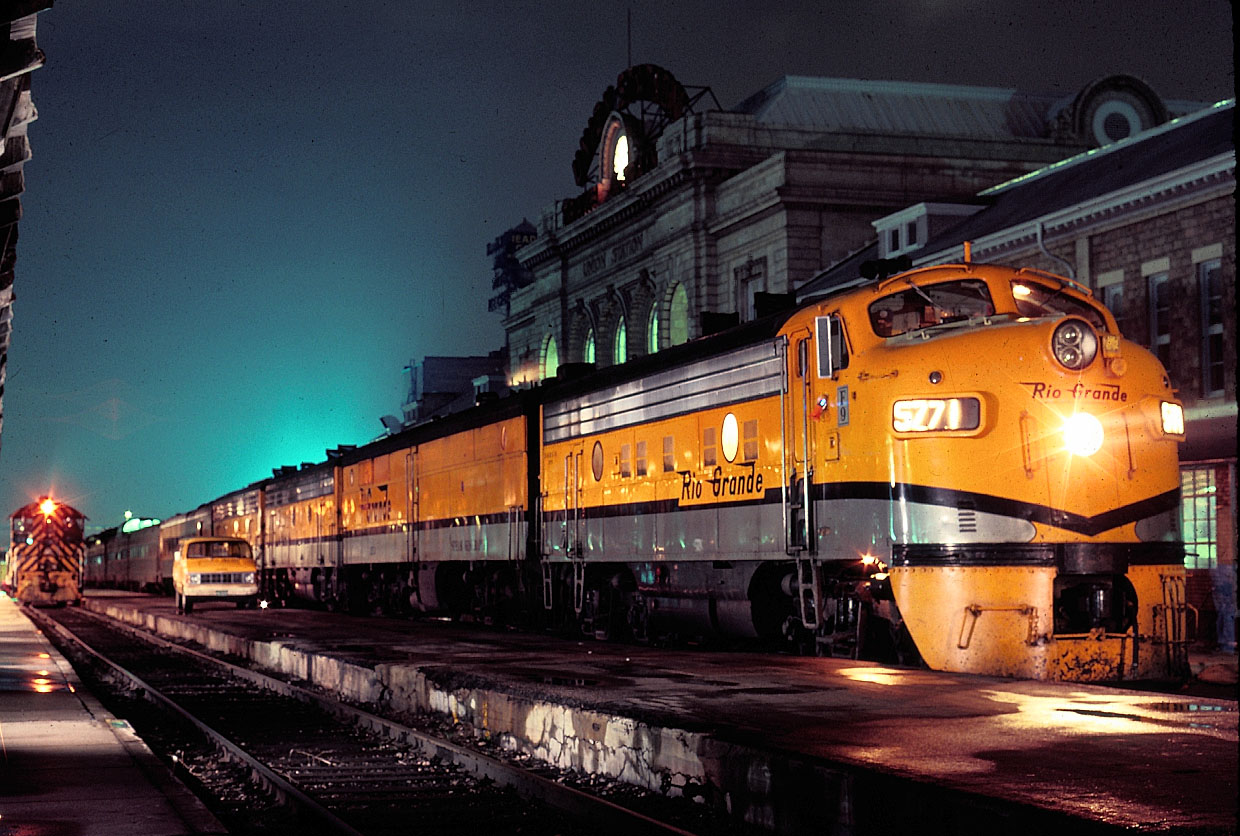 Move on to the 1960s. Don't get me wrong. Passenger Rail was already on the skids in the late 50s. By the early 60s, no skids were left underneath and it was almost free fall. The airlines and the Interstate Highway System took big public money and made mincemeat of the Passenger Rail system. The ICC paid lip service to competition and public necessity, but nobody thought of rail as a "modern" form of transportation, least of all Congress. Regulation threatened to end railroading completely.
The onset of Amtrak . . . yes, it had an onset just like a disease . . . brought relief to the rail systems vis a vis removal of a nasty red line from the ledger, but it wasn't a panacea, and Congress was as stingy as it could get. A subsidiary disease is something I would call Turn-a-Profit-Itis. Or make that last part -oma. It's a cancer that has to be cut out of our thinking about transportation policy before it kills the patient.
Ebb and flow continued as Congress and Administrations would alternately fund and defund things, install new Amtrak administrators, and boards, and decide arbitrarily how bad the "-oma" would be. Ebb and flow.
 Now we have a national system that needs a lot of work. Congress under the current administration -- it's more of a custodian -- gave Amtrak enough money for some new equipment, but not enough for new routes. The rebuild of the Northeast Corridor needs a rebuild. Somewhere along the line, Congress had the brilliant idea that the individual states would have to kick in for service, and this regulation has been administered so arbitrarily that there are some state legislatures that will eventually either want to opt out or have to as the state goes belly up. Others have embraced this bugaboo wholeheartedly and have succeeded at it for the most part. California, Illinois, Michigan, Washington come to mind. Note they are also highly liberal states.
 So in a way, we also have the ebb and flow of a once private network of passenger railroads turning into a smaller public entity, now being spun off to become something less of a single entity and more of a network again, with the very real possibility that some states will find private operators, and maybe even private owners, willing to run Passenger Rail again. (Florida, perhaps California, Oklahoma?)
Ebb and Flow.
©2014 - C. A. Turek - mistertrains@gmail.com
During the first decade of my life, Passenger Rail was full flow. Post WWII streamliners came on line faster than Sbarro on Manhattan Island. No matter what the railroad was running things, a serious effort to please the traveling public and make Passenger Rail competitive with air travel and highways created the grand days of 20th century rail travel. The big ones come to mind. The Super Chief, The Broadway, The 20th Century Limited, The City streamliners, The North Coast Limited, The Empire Builder. There are lots more, but my childhood was centered on the midwest, so forgive my omissions.The onset of Amtrak . . . yes, it had an onset just like a disease . . . brought relief to the rail systems vis a vis removal of a nasty red line from the ledger, but it wasn't a panacea, and Congress was as stingy as it could get. A subsidiary disease is something I would call Turn-a-Profit-Itis. Or make that last part -oma. It's a cancer that has to be cut out of our thinking about transportation policy before it kills the patient.
Ebb and flow continued as Congress and Administrations would alternately fund and defund things, install new Amtrak administrators, and boards, and decide arbitrarily how bad the "-oma" would be. Ebb and flow.
Ebb and Flow.
©2014 - C. A. Turek - mistertrains@gmail.com
Saturday, April 26, 2014
Freight v. Passenger Rail
.jpg)
The oil boom and consequential uptick in the number of "oil cans" on U.S. rails has illuminated a certainty I've observed for some time. Basically, it's that passenger trains no longer get the priority they need to be a viable form of medium- to long-distance travel. The exceptions are the tracks owned by Amtrak and commuter rail authorities, where the track owners can choose to give passenger trains priority. Often they don't. The problem is just going to get worse, as the feds have found out they can foist costs off on the states by blackmailing them with the loss of train service. (See Southwest Chief in Colorado, New Mexico, and Kansas.)
I'm not arguing that freight should never get priority--far from it. Seeing that freight rail is possible the most energy efficient way to move heavy loads anywhere on the planet (marine is most efficient where there is a waterway and a port), a robust freight rail system, with marketplace competition and free from burdensome regulation, is necessary for future economic success. But passenger rail also approaches optimum efficiency for moving people. What are we to do?
I've made no secret that I'm not a fan of High Speed Rail (HSR), but that's mainly because of the way America is going about it. Piecemeal doesn't cut it. At the current level of funding, Amtrak will turn into a fragmented, useless entity for anything but trains on the Northeast Corridor and some other Corridor trains. Beyond those corridors and regional transportation agencies, passenger rail will disappear.
I do not now and never have given purchase to the argument that the federal government can't make enough cuts to fund something really important. But, with the media in the corner of the politicians, it would take one helluva piece of investigative journalism pitched to the public by one helluva believable news personality to demonstrate that the wool has been pulled over our eyes for years. Forever for younger folks. Once we free up all that taxpayer money, put it into a real network of HSR.
The professional politicians will never let this happen.
Some additional links: http://krcc.org/post/railroad-west-trinidad-freight-and-passenger-rail-are-linked
http://www.abqjournal.com/389258/news/santa-felamy-passenger-rail-trips-look-set-to-return.html
http://motherboard.vice.com/blog/the-us-oil-boom-is-putting-the-squeeze-on-amtrak
http://www.bizjournals.com/albuquerque/news/2014/04/22/nm-railroads-to-focus-on-freight-not-passengers.html?page=all
©2014 - C. A. Turek - mistertrains@gmail.com
Wednesday, April 02, 2014
Please People!
This could have been a lot worse.
At least nobody was killed. I'll let you use your imagination what the injuries in the SUV could have been like.
As light rail, commuter rail, and passenger rail in general gets more and more popular, we need to get back some of the common sense that people had back when streetcars and frequent and fast passenger trains were the norm.
©2014 C. A. Turek - mistertrains@gmail.com
At least nobody was killed. I'll let you use your imagination what the injuries in the SUV could have been like.
As light rail, commuter rail, and passenger rail in general gets more and more popular, we need to get back some of the common sense that people had back when streetcars and frequent and fast passenger trains were the norm.
©2014 C. A. Turek - mistertrains@gmail.com
Subscribe to:
Posts (Atom)